
Blogs
Pm Modi's masterclass in leadership communication
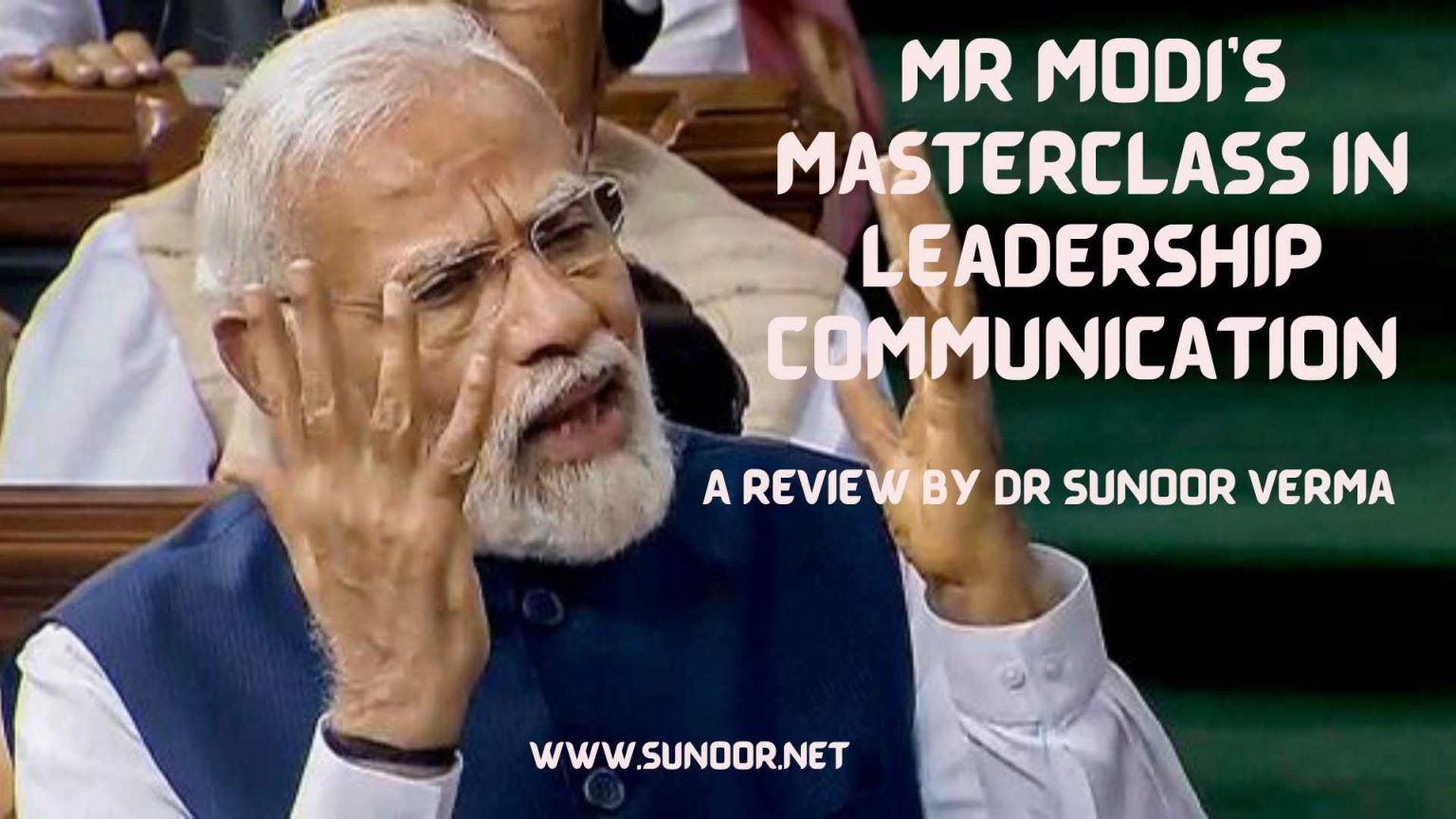
India’s Prime Minister, Mr Narendra Modi, delivered a master class in political #LeadershipCommunication in parliament on August 10, 2023, when a no-confidence resolution was presented against his administration. Mr Modi accused the opposition of having no faith in India, believing those who mocked the country, and being arrogant and incompetent. He also stated that the more they tried to stop him, the more successful he became.
: First and foremost, it was well-timed. The no-confidence resolution was introduced two days after Mr Modi’s party, the BJP won the municipal by-elections in Gujarat. This allowed Mr Modi to capitalize on the BJP’s momentum and depict the opposition as out of touch with the country’s spirit. As a result, this speech can also be classified under #StrategicCommunication.
: First and foremost, it was well-timed. The no-confidence resolution was introduced two days after Mr Modi’s party, the BJP won the municipal by-elections in Gujarat. This allowed Mr Modi to capitalize on the BJP’s momentum and depict the opposition as out of touch with the country’s spirit. As a result, this speech can also be classified under #StrategicCommunication.
: Mr Modi addressed his remarks with passion and conviction. He addressed the people personally and stated unequivocally that he would not back down from the opposition’s challenges. This added urgency and enthusiasm to his address, which helped energize his followers.
How He Used Rhetorical Devices to Connect with the Audience Mr Modi’s grasp of Hindi was a significant asset in the no-confidence vote. Despite being a non-native speaker, he could communicate with his audience in Hindi fluently and confidently. In contrast, his opponents were not fluent in Hindi and frequently made errors. This enhanced Mr Modi’s credibility and intelligence, giving him an advantage in the argument.
Mr Modi’s body language, in addition to his rhetorical abilities, contributed to the effectiveness of his speech. He conveyed confidence, authority, and determination through various nonverbal cues.
Here are some specific examples of how Mr Modi’s body language worked in his favour: Mr Modi’s outfit also contributed to his image of power and confidence. The white kurta-pyjama represents purity, but the Nehru jacket represents power and authority. This confluence of symbols aided Mr Modi in projecting an image of a strong and capable leader who was in touch with the people. His formal dress made him appear more powerful and in charge when he accused the opposition of being out of touch with the people. Similarly, as he discussed India’s accomplishments, his immaculate dress made him appear proud and confident. On the other hand, his projected opponent wore a white half-sleeve shirt that conveyed informality and casualness.
Public Health Debates We Can Ignore At Our Own Peril
Global lessons learnt are not as valuable as we might think!
Having lived and worked in low-, middle- and high-income countries, I do not like sweeping ‘global lessons learnt’. The situational, cultural, and operational contexts based on countries’ income levels vary hugely. Moreover, the reports and recommendations from global apex bodies are often drafted by people from primarily high-income country experiences. Many of them may have never actually worked at the country level. Often their lexica are so watered down in assessments of low-income countries that severe reprimand ends up sounding like applause by publication. Without a scorecard system where each country would know where they need to improve to achieve standards, it is difficult to get a reality check. We, the low-income countries, have a choice to make. We can believe that we are high performers or quench our vanity, critically examine our performance, and take corrective measures.
The glaring gaps in public health that COVID-19 exposed
COVID-19 has exposed critical societal gaps across the globe. In the case of high-income-developed democracies, this means adjustments and fine-tuning. In the case of low-income countries, this has meant seeing a horrid picture in the mirror and the need for transformational change. So a natural enquiry would be-what has been happening in the business of Health Systems Strengthening over the years and billions of donated dollars later? We would have thought that SARS, Ebola, MERS and ZIKA emergencies would have better prepared our health systems, but here we are.
This pandemic has opened some chronic societal wounds, especially in low-income countries. The top issue that warrants an urgent societal debate is what services are essential and must remain in the public domain and how we regulate the private sector. Many proponents for the rapid privatisation of public services in low-income countries are foreign experts. Their countries have achieved an equilibrium between top-notch public services and effective private-sector regulation.
Public Health, Corruption & Transparency
Corruption, lack of transparency, power asymmetry, and invisibility of women in decision-making all contribute to the complexity of public versus private debate in low-income countries. When lawmakers overtly or by proxy own significant numbers of private hospitals, mainstream media, and educational institutions, it becomes difficult to have an objective national debate. The COVID-19 pandemic has allowed us to rethink and reboot societal contracts. The pandemic struck when public trust in institutions- governmental, civil society, private sector, media, academia, and the judiciary was at the lowest after years of steady decline globally.
Public sector- the saviour during COVID-19
Suppose we reflect on the past two years of the pandemic in low-income countries. In that case, we will note that we turned to either the public sector organisation or the defence forces whenever we needed a timely nationwide response. For example, when students needed to be brought back from abroad in India, the then-national carrier Air India stepped up. When stranded migrant workers needed to return home, it was the Indian Railways that rose to the occasion. When liquid oxygen had to be mobilised, the public sector was at work again. Working around the clock to secure scarce supplies from other countries and securing evacuation permissions were diplomats who are public servants. On the borders, facilitating the movement of people, supporting testing, quarantine etc., were members of the border police, armed forces, and the police. Similar was the case with many countries in South and Southeast Asia.
Other rich countries, such as Germany and South Korea, responded robustly. Attribution to the ability of their governments to manage private-sector activity and essentially public ownership of critical health system elements. Their impressive testing capacity was thanks to public laboratories and the presence of industries that could supply the required safety equipment and chemicals.
The South and Southeast Asia neighbourhood
Some governments in Southeast Asia have managed to build public health systems that learn. So, lessons from SARS and Tsunami have fed into their preparedness systems, allowing them to respond efficiently and effectively. The city-state of Singapore has traditionally shown a proactive approach based on solid scenario planning and proactive public health communication. Within India, the response of the southern state of Kerala has stood out. Over the decades, Kerala has invested in health, education, and women’s empowerment. It has consistently adopted an evidence-based approach to decision-making on health matters. Theirs is a learning system that drew heavily on lessons from the NIPAH virus emergency not too long ago. Kerala has also avoided the black-and-white notion of Public or Private and established a successful public-private partnership model. The government of Vietnam efficiently diagnosed the regional situation and closed its borders. Similarly, they were swift in developing low-cost test kits.
Public Health and the private vs public discourse- an axis of national security too
The considerations that need to be at the centre of this post-COVID-19 public-private discourse are:
- Re-evaluate and reign in the privatisation spree of health-related assets and services. Nurture back to health underperforming units through quick and transparent reform.
- Two, Reboot and relaunch sensible and practical national health policies that serve the objective of achieving universal health coverage. These should not be a copy-paste of what middle- or high-income countries are doing but should be rooted in the realities of poverty, patriarchy, and emerging democracy.
- Three, While the issue may appear to be of health, the scope of solution searching is well beyond the expertise or experience of health actors. The complexity of this matter warrants the leadership of the Ministries of Finance, Law, Commerce and Home. For example, supply chains, the rule of law during the lockdown, transportation of people, and labour issues related to health workers have solutions outside of health agencies’ remit.
- Four, Governments must take the lead and regulate the private sector more effectively and transparently. While governing the somewhat more streamlined public sector may be more satisfying, the rapidly and wildly growing private sector needs aggressive regulation. In many low-income countries, this means enforcing the existing fantastic on-paper rules and not drafting new ones. Moreover, the hopelessness of data collection from private sector health providers, whether on testing, bed occupancy, oxygen availability, or mortality during COVID-19, has hampered many low-income countries’ effective and timely response.
Refocusing on the Health for All agenda
This public discourse requires us to open our eyes to what we witnessed in the last two years and set aside our ambition and vanity. Let us acknowledge the actual situation in our countries and not artificially push ourselves into a higher boxing category for mere prestige. Organic, home-grown solutions are needed now, not a collage of random international best practices. Instead of drawing lessons from countries in the region, we need to study states and provinces with similar challenges and partner with them. Cross-border areas should be of interest in standard solution searching.
Many glorious careers are built worldwide in the name of Health Systems Strengthening. However, COVID-19 has shown that not much strengthening may have happened. WHO’s “Health for All” agenda ought to remain our focus. However, the tools, processes and commitment need to be indigenous. Countries must bring their sharpest, most independent, and most fearless minds to this debate.
Let us not forget that health, education, and security are nation-building tools. Taxpayers will have little incentive to contribute their fair share if all these continue being disproportionately privatised. One can only imagine the threat to democracy this will pose.
About the Author
Dr Sunoor Verma is a global health practitioner. He has advised WHO, UNICEF, UNHCR, HUG-Geneva and Cambridge University on Strategy, Leadership Communication, Advocacy and Resource Mobilization. He is credited with setting up WHO’s communication portfolio from scratch in Nepal in the midst of COVID-19. He has set up and led the country and regional operations for the European Centre for Minority Issues in the Balkans. He has supported track two peace processes in Macedonia, Kosovo and Sri Lanka and emergency response to the Tsunami, Avian Influenza and COVID-19. He has taught Global Health at Boston University. He has curated partnership initiatives with Macedonia, Kosovo, Germany, Switzerland, Australia, and Nepal parliamentarians. He divides his time between the foothills of the Jura Mountains in France and Buddhanilkantha in Nepal.
Published in Nepal’s national daily Kantipur on 30 June 2022 in Nepali language. This is a translation with some additional text.
The WHO Is Not Our Nanny!
IS WHO OUR GLOBAL HEALTH NANNY?
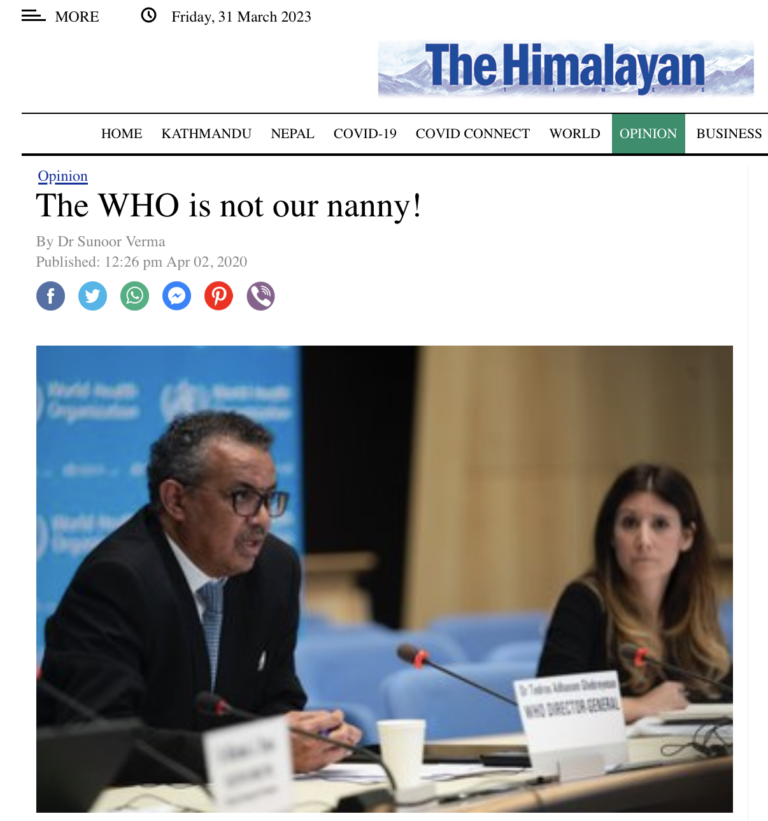
Expecting the World Health Organisation (WHO) to be our universal nanny is unrealistic and dangerous, especially in times of crisis. WHO is a body that brings together global expertise, health intelligence and experience to all its member states. Every organisation essentially represents the nature of its membership and what its members want it to be. WHO is made by your governments. Countries must take WHO's guidance as their core 'plan minimum' and add to it their wisdom.
IMAGINE THE COVID-19 RESPONSE WITHOUT THE WHO
Gripped by COVID-19, all eyes are on WHO for guidance on what to do and what not to do? All it takes is to imagine our response to the pandemic without the WHO. All said and done common perception is that this is an organisation owned by member states and would be the closest that we could get to neutral information. Many criticise WHO for being influenced by one powerful state or another. However, no one has developed an alternative body that would enjoy the reach or brand recognition of WHO while maintaining the entire range of health expertise from epidemics to road injuries. Governments quote the WHO, and follow its guidance and feedback data into it. The network of collaborative centres that the WHO operates in partnerships with academia and government is an immense asset to the global pool of knowledge and capacity.
What started as a health crisis has very rapidly evolved into a societal crisis. Some countries have declared COVID-19 a national security crisis, some have termed it a national disaster, and others have termed it a war. It is essential in this context to understand the role of the WHO, lower our expectations of it and shift specific tasks and responsibilities to other actors.
SHIFT EXPECTATIONS AWAY FROM WHO TO OTHER AGENCIES
While the WHO teams around the globe churn out a range of information material on how to deal with COVID19, other actors need to take that information forward to their constituents. Take, for example, the WHO's social distancing guidelines. These ought to be taken up by organisations within countries, modified to the local context, translated into the local languages and amplified using channels that work best in that given context. Marinating in inaction, awaiting tailor-made guidance for every population segment for every country is a luxury we can not afford now. In the country context, line ministries need to step up their game and use their intelligence to customise the science coming out of the WHO and channel it to their captive audiences. Spoon-feeding is not an option in times of crisis. Similar to the WHO, as Ministries of Health are overwhelmed in responding to the COVID19, line ministries should not self-paralyse for lack of vetting of each communication piece from their Ministry of Health counterparts. There is neither time nor any human resources that can be spared for this. In multiplying and amplifying messages, mistakes might be made here and there, but they can be corrected. The risk of doing nothing is way higher than making a few mistakes.
HELP WHO DELIVER ON ITS CORE MANDATE
Every emergency coordination meeting I have attended at a country, regional or headquarters level invariably ends with one default recommendation- we must coordinate better. Pick any emergency response evaluation, and you will see the same outcome. While coordination during a crisis may hold some limited promise within sectors-e.g. UN country teams, International NGOs, and government ministries, it rarely works between industries. It is no different from how things function or don't within a building of tenants or extended family-some will always go solo or only halfheartedly implement agreements. I have found this to be valid as emergencies draw out. In a COVID-19 global crisis, let us allow WHO to focus on giving the world its best technical intelligence and advice. Let us not put it under the expectation of global babysitting. It is the time to encourage all other ministries, organisations, industrial bodies, and associations to study, digest and use the WHO's knowledge and advance it to their audiences as quickly as possible using their innate intelligence and experience.
Let us help the WHO focus on its core knowledge generation and dissemination business. It is time for each of us to step up to our duty of using WHO's output responsibly and proactively in beating the menace of COVID19.
ABOUT THE AUTHOR
Dr Sunoor Verma is a former Cardiothoracic surgeon; his experience ranges from various emergency settings related to the Avian Flu, SARS, Tsunami, HIV/AIDS, Kosovo crisis, Macedonia armed conflict and the Sri Lanka conflict. His focus is Strategy, Risk and Crisis Communication and Strategic Partnerships in international development. He has advised WHO, UNICEF UNHCR, the European Centre for Minority Issues, Cambridge University, Boston University and the Hospitals of the University of Geneva. He balances his high-level policy work with advisory work to grassroots NGOs worldwide. He works out of the Lake Geneva region.
Collective Action Needed To Exit From Covid-19 Crisis
WHAT SHOULD THE ROLES OF GOVERNMENT, PRIVATE SECTOR AND THE GENERAL PUBLIC BE IN TERMS OF CRISIS COMMUNICATION?
Crisis communication is very different from regular communication. This is because the way people perceive threat, process information and react to information is very different from that of the regular scenario.
The other challenge we face in the globally connected media is that we are watching what is happening in developed countries. Suddenly our own expectations from our own governments become unrealistically high. But we have to realise our own context and manage our expectations in that context.
Governments need to see that people expect information quickly to make themselves and their close ones safe. Second, they want reliable information. Third, they want information they can turn into action for themselves so that they can take their safety into their own hands.
The people need reliable information from governments, and governments need collaboration and cooperation from the people. These two elements need to be in harmony. For that to happen, there needs to be a single source of information that is trusted. In the case of this epidemic, the official government mechanism and the World Health Organisation are the only two sources from where we take the information.
Then there's the role of leaders in other sectors. Leaders do not only mean elected leaders. We are looking at leadership from all sectors - within the private sector, the faith sector, and within the community sector.
For example, if I am a shopkeeper in Kathmandu, I should not expect the government or WHO to come up with a protocol on how to maintain social distancing at the shop. Shopkeepers, or their associations, should decide how we manage social distancing at shops.
Also, videos on how to wash hands from developed countries show people washing their hands for 30 seconds under running water. Where do we get running water in Nepal? Our reality is a mug of water. We need a video on how to wash our hands with a mug of water for 30 seconds. This is not something we expect the government or the WHO to come up with. There are so many creators, YouTube stars and influencers. They can make their 30-second video.
It should be clear there's no individual exit from this. The only way we can exit from this is through collective action. So this is the first time, I think, we are facing a crisis where it does not matter whether you are rich or poor; literate or illiterate; male or female; Hindu or Muslim or Buddhist.
Your survival depends on your neighbour. This is a massive equaliser. So crisis communication needs to be mastered very quickly by leaders in all spheres of life.
HOW CAN THE PRIVATE SECTOR, WHICH HAS YET TO COME OUT IN NEPAL, ADDRESS THIS CRISIS?
It is very important for the private sector to step up to see what the government is doing and immediately come up with offers of action and support. This is not the time to negotiate product placement, visibility, brand logo, etc. This is the time for the private sector to unite most effectively through their associations. That way, the interests are not competing within companies or brands. It's an industry coming together.
For example, an industry of manufacturers comes together. See what the government is doing. See what the messaging is and think about how they can take the message forward into areas they influence. How they can multiply and amplify the message and make it more understandable for their constituents. They must also start thinking of scenarios in future planning. At the moment, we are all thinking about the crisis. We are not thinking after the crisis.
When the private sector starts helping out, the government will also probably ask the private sector for things they could do. For example, Airbus and Rolls Royce are presently not manufacturing aeroplanes or engines, but they are manufacturing ventilators.
EVERYWHERE IN THE WORLD, COUNTRIES ARE FOLLOWING ONE MODEL OF LOCKDOWN TO SLOW DOWN THE SPREAD OF NOVEL CORONAVIRUS. HOW SUSTAINABLE IS THAT MODEL, ESPECIALLY FOR A COUNTRY LIKE NEPAL WHERE PEOPLE HAVE TO GO OUT TO WORK EVERY DAY TO EKE OUT A LIVING?
This is where multilateralism comes in. Countries, no matter how independent and how proud, this crisis reminds us we are not independent but we are interdependent. So when we are interdependent, we have to use each other's strengths to understand who is working how and resolving the problems through which means, and pick from there.
This is where multilateralism, regionalism, regional cooperation all come in. You can see China has sent a medical team to Italy. Cuba has just sent 50 doctors to Italy as well. So we need to see our partners who can help us in what manner. And help is not just with financial aid but with ideas. We also have to realise that solutions will emerge as we move on.
The other thing that we should ask ourselves is what the other option to the model of lockdown there is. Let's start with the one option we've seen working everywhere until we have another option. In the meantime, we develop solutions as they emerge or as the problem evolves. But I do not think we have the luxury of waiting.
IS THIS CRISIS FORCING EVERYBODY, EVEN THOSE WRITING OFF MULTILATERALISM, TO RETHINK IT?
Multilateralism is criticised because it is a soft and favourite punching bag for everyone. Any organisation, in essence, reflects the members it has. The United Nations is what its members are and what its members want it to be. But it is an easy punching bag because it is not easy for a country to go and punch an individual member which is more affluent, bigger and more powerful. But the COVID-19 crisis is reminding us about the importance of the WHO with its vast networks of collaborators of laboratories around the world, sharing information, pooling data and working 24 hours a day. If this system of multilateralism was not there, you would not have the WHO. Then the question would be, whose information would you trust? Of course, the UN system has to reflect modern society. But it is very big, and it takes time to change. Member states have to also think about it.
You have the luxury of so many UN agencies in Nepal. These agencies have programmes around the countries. So here you have channels and expertise spread around the country from a multilateral organisation where you are a member, where you can demand help. The UN offices are open, and all the heads of the UN agencies are in their offices.
HOW DO YOU THINK THIS CRISIS IS GOING TO END AS PEOPLE PAINT A GLOOMY PICTURE?
This whole experience poses questions on how we function as a society and in governance. So people and governments have a choice - will they make decisions based on scientific evidence? The second choice is whether we are going to support the public health sector or not. You can see the delay in response to COVID-19 in the US is attributed by many to reduced funding of the public health sector in the last few years.
In terms of the gloomy picture, science tells us virus evolves. The whole idea of the lockdown is to delay how the virus moves from one person to another. Hopefully, several parameters will change until we manage to postpone this, such as heat and humidity and hopefully, infections go down. So I think the evolution would gradually become that of the flu. It might re-emerge in November or December when seasonal flu occurs, but most scientists feel the virus would have evolved or mutated by then. But I think we do not have the luxury of long-term scenario planning in a crisis like this. We need to start step by step based on the experience that is evident around us. China has managed to bring it under control, South Korea is doing quite well, and Taiwan and Singapore have done quite well.
If you look at countries that have done well, they have been very strong in crisis communication and supply chain management. I think many of these countries have outstanding relations with Nepal. I think the way forward is to seek their expertise and support. Nepal is a full-fledged member of the United Nations. There's immense recognition of Nepal's contribution to the peacekeeping forces. Nepal has helped the world. Now Nepal needs help; I think the world will stand to support Nepal.
ABOUT THE AUTHOR
Sunoor Verma is a senior international development specialist in strategic planning, strategic and risk communications and strategic partnerships. His experience includes advisory work for the World Health Organisation, UNHCR, UNICEF, European Centre for Minority Issues, Cambridge University, University of Geneva and Boston University. Most recently, he consulted WHO-Geneva on developing their Risk Communication Strategy for Pandemic influenza.
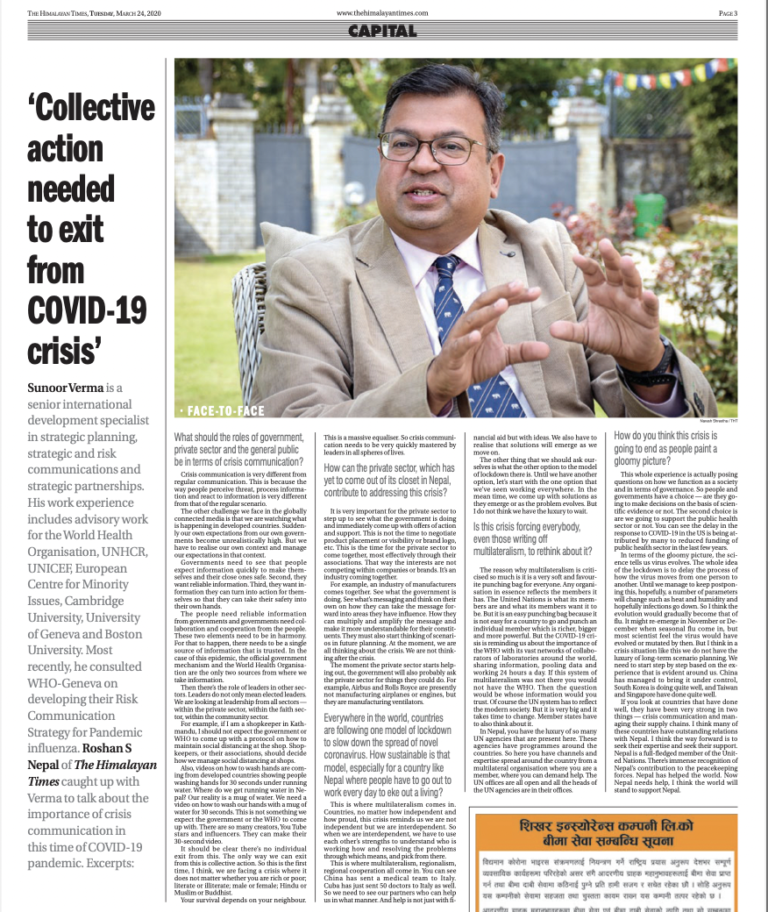
Roshan S Nepal of The Himalayan Times caught up with Dr Sunoor to talk about the importance of crisis communication in this time of COVID-19 pandemic. Published on 24th March 2020 in The Himalayan Times English national daily newspaper Nepal.